Ukulele Sizes: Soprano, Concert, Tenor or Baritone?
Ukuleles come in four common sizes: soprano, concert, tenor and baritone. The first three share the same G–C–E–A tuning, so the chord shapes in a beginner book work on all of them. The baritone is tuned differently. In practice, the size changes how far apart the frets are, how big the body is and how full the sound feels.
The four sizes at a glance
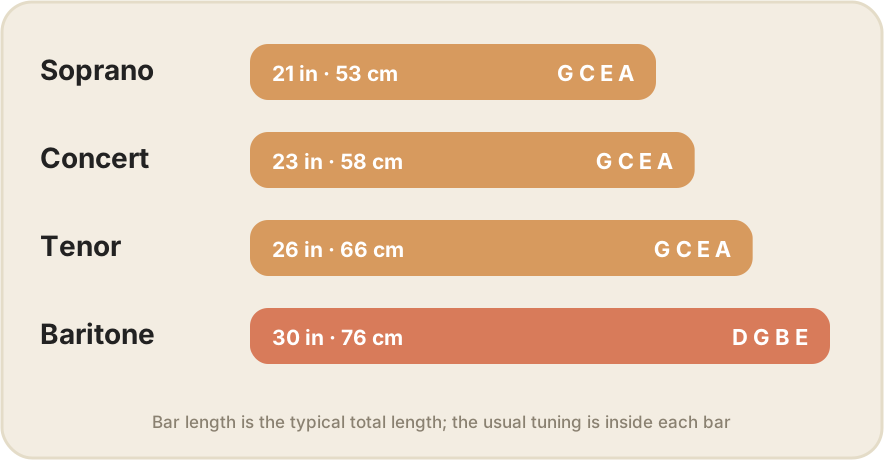
| Size | Typical total length | Usual tuning | What it feels like |
|---|---|---|---|
| Soprano | about 21 in (53 cm) | G–C–E–A | Smallest and lightest, frets close together, the classic bright ukulele sound |
| Concert | about 23 in (58 cm) | G–C–E–A | A little more room between the frets and a slightly fuller sound |
| Tenor | about 26 in (66 cm) | G–C–E–A, often with a low G | Wider fret spacing, a rounder and fuller sound |
| Baritone | about 30 in (76 cm) | D–G–B–E | Closest to a small guitar, the deepest voice |
The lengths are approximate and makers differ a little, so check the size on the listing. A “21-inch ukulele” is a soprano.
What changes when the size changes
- Fret spacing. A short neck puts the frets close together. That is comfortable for small hands, but large fingers can feel cramped. A longer neck gives more room and asks for a longer stretch.
- Sound. Smaller bodies tend to sound brighter and lighter, larger ones fuller. The wood, the strings and the build matter as much as the size.
- Tuning. Soprano, concert and tenor use the same four note names, so a chord diagram for G–C–E–A works on all three. A tenor often carries a low G; see high G vs low G.
- Baritone chords. A baritone is tuned like the top four strings of a guitar, a fourth lower than the other sizes. A chord shape from a ukulele chart still works, but it sounds as a different chord: the C shape sounds as G. If you follow a ukulele chart on a baritone, use guitar shapes or shift the chart.
How to choose
- First ukulele, small hands or a child: soprano. It is the easiest to hold and carry.
- Adult beginner who is not sure: concert. It is a sensible middle: more room for the fingers than a soprano, still compact.
- Larger hands, or you want a fuller sound or a low G: tenor.
- You already play guitar and want guitar chord shapes: baritone.
You do not lock yourself in. What you learn on one of the G–C–E–A sizes (chord shapes, strumming, timing) carries over to the others.
Check before you buy
- Hold it. Reach the first five frets without strain and see whether your fingers fit between the frets.
- Pick each string. Open strings should ring cleanly, with no buzz.
- Test the tuning. Tune it, play it for a few minutes and check it again. If it drifts quickly, read why a ukulele will not stay in tune.
- Compare the open string with the 12th fret. The fretted note should be the same note an octave higher. If it sounds sharp or flat, the instrument may need setup.
We have not compared brands, so this lesson does not recommend one. A shop that lets you hold a few instruments teaches you more than a spec sheet.
In short
If you are not sure, start with a concert. If you want the smallest and lightest, choose a soprano. Choose a tenor for bigger hands or a fuller sound, and a baritone if you want guitar shapes and a deep voice.
Next: tune your new ukulele step by step, then learn your first chords.
In Uku you can add your own ukulele by size (soprano, concert, tenor or baritone). Get it for iPhone and iPad; features follow the app’s trial and unlock terms.