F Ukulele Chord: Check the Open Strings and Keep Your Am Finger
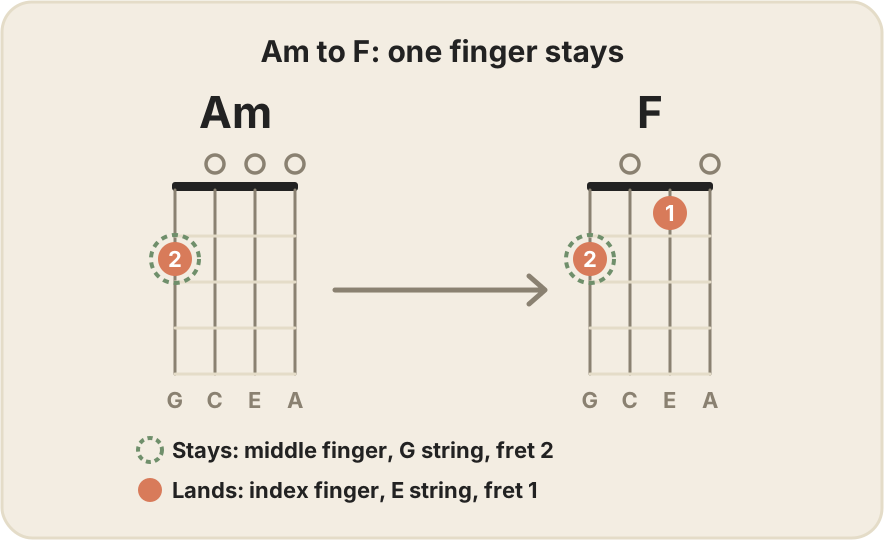
F is a good first test of finger placement because it needs only two fingers, but those fingers must stay out of the way of two open strings. In G–C–E–A tuning the numbers, string 4 to string 1, are 2–0–1–0: the G string at fret 2, the C string open, the E string at fret 1 and the A string open.
The shape
One comfortable choice is the middle finger on G, fret 2, and the index finger on E, fret 1. This is the suggestion in our first-chord guide. If another fingering gives clear notes and makes the next change easier, use it.
Check the open strings
Pluck the strings one at a time, string 4 to string 1.
- G, fret 2 and E, fret 1 should sound clear and not buzz.
- C and A are open and should ring until they fade. If either is dull, the index finger or the base of it is probably touching it. Arch the finger and press with the tip.
Do this before you strum. A strum only tells you that the chord sounds wrong; plucking tells you which string it is.
Keep your finger when moving between Am and F
Am is 2–0–0–0, so its only fretted note is G at fret 2, the same note the middle finger holds in F. To go from Am to F, keep the middle finger where it is and add the index finger on E, fret 1. To go back, lift only the index finger.
Practise Am | F | Am | F, one bar each, with one strum on beat 1. Count beats 2 and 3 with the middle finger still on G. Use beat 4 to bring in the index finger or to lift it. If the arrival is late, lower the tempo.
When this is steady, return to changing chords without stopping the beat. If a string stays dull, see muted chords.
Want to repeat Am and F slowly? Get Uku and explore its practice features under the app’s trial and unlock terms.