How to Tune a Ukulele: GCEA, String Order and First Steps
Most soprano, concert and tenor ukuleles use G–C–E–A tuning. Start by checking the tuning and string set your instrument is intended to use. Baritone and other setups may be different.
Identify the strings before you turn a peg
For a conventional right-handed setup, hold the instrument in playing position. The string nearest your face is string 4, G. Continue toward the floor: string 3 C, string 2 E, string 1 A. These instructions describe physical string order, not lowest-to-highest pitch.
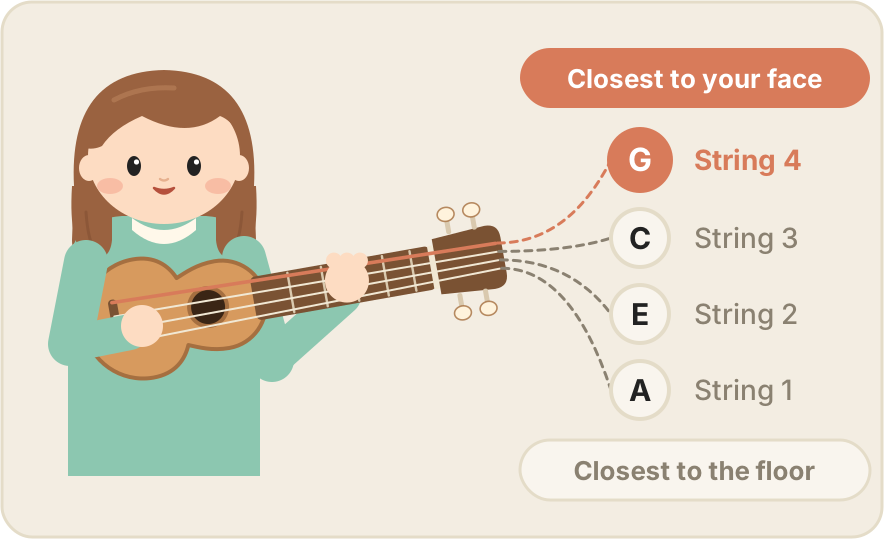
| String | Standard high-G target | Frequency at A4 = 440 Hz |
|---|---|---|
| 4 | G4 | about 392 Hz |
| 3 | C4 | about 261.63 Hz |
| 2 | E4 | about 329.63 Hz |
| 1 | A4 | 440 Hz |
A low-G setup changes G4 to G3, about 196 Hz. Do not try to turn a high-G string down an octave simply because a diagram says “low G”; confirm the appropriate string set first.
Tune one string at a time
- Choose standard high G or your instrument’s actual tuning in your tuner.
- Pluck only G and let it ring. Keep the other strings quiet.
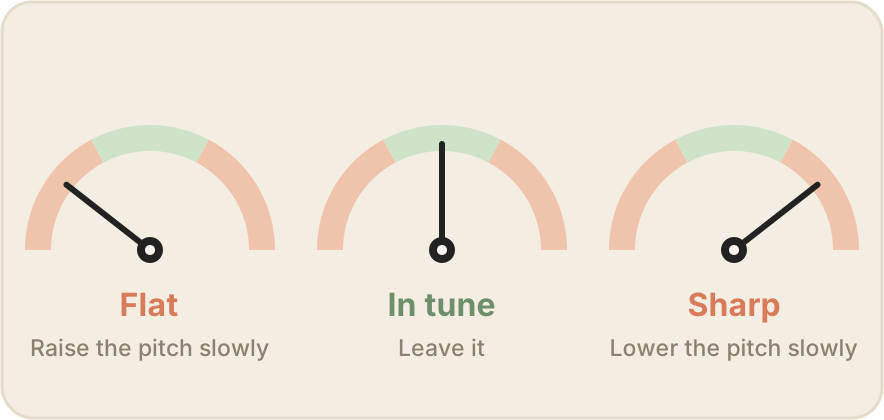
- If the pitch is below the correct target octave, raise it slowly; if it is above, lower it slowly. Watch the tuner rather than assuming every peg turns the same way.
- Make a small adjustment, pluck again, and wait for a steady reading.
- Repeat for C, E and A, then check all four once more.
If the tuner shows a different letter or the pitch is far away, stop and confirm the target before making a large adjustment. Increasing tension toward the wrong octave can damage a string.
A one-minute check
Pluck G, C, E and A separately. Say each name out loud, wait for the reading, and make only the adjustment needed. Then play a C chord. A chord can still sound rough because of fingering, so check open strings again before assuming the whole instrument is out of tune.
Next: learn your first chords. If the pitch keeps drifting, see why a ukulele will not stay in tune.
Want a guided check on your phone? Get Uku for iPhone and iPad. The tuner is free; advanced practice features have separate trial and unlock terms.