How to Change Ukulele Chords Without Stopping the Beat
If every chord change stops the music, separate the finger movement from the strumming pattern. Use two chords, a slow pulse and one downstroke per bar before asking both hands to do more.
Learn the movement first
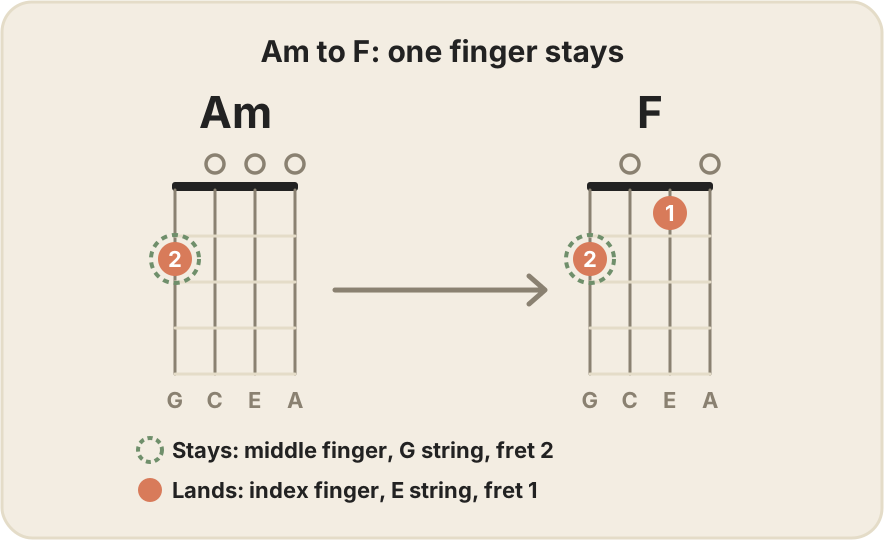
Try Am → F in GCEA tuning. With the suggested shapes in our first-chord guide, the middle finger can stay on G, fret 2, while the index finger lands on E, fret 1. Notice this shared position rather than lifting every finger.
For C → Am, there is no shared held note in these shapes. Move deliberately and keep unnecessary finger travel small. A different pair may need a different strategy.
Use a four-beat preparation loop
- Hold C and strum on beat 1.
- Count beats 2, 3 and 4 while preparing Am.
- Strum Am on the next beat 1.
- Repeat, then reverse the direction.
Some notes may stop ringing while you move. In this exercise, keeping the count is the first goal; sustaining every note comes later. If you cannot arrive comfortably, lower the tempo or give each chord two bars.
Three short rounds
Spend 30 seconds on C–Am, 30 seconds on Am–F, and 30 seconds on F–G7. Between rounds, pluck each chord one string at a time. Finish with C | Am | F | G7, one bar each and one strum on beat 1.
Judge progress by whether the arrival is more predictable and the notes are clearer at the same tempo. A high number of changes is not useful if the shapes are incomplete.
When the simple loop works, add four downstrokes per bar. Only then try a more complicated strumming pattern.
Want to slow down a difficult section and repeat it? Get Uku and explore its practice features under the app’s trial and unlock terms.