Muted Ukulele Chords: Find the Dull String One by One
When a chord sounds dull, usually one string is not ringing clearly. Do not try to fix all four at once. Find the string first, then change one thing.
Pluck, listen and name the string
- Make the chord shape and hold it.
- Pluck string 4 (G) alone and let it ring. Then string 3 (C), string 2 (E) and string 1 (A).
- Listen for the string that sounds short, buzzy or dead. Open strings should ring until they fade.
- Say which string it was before you change anything.
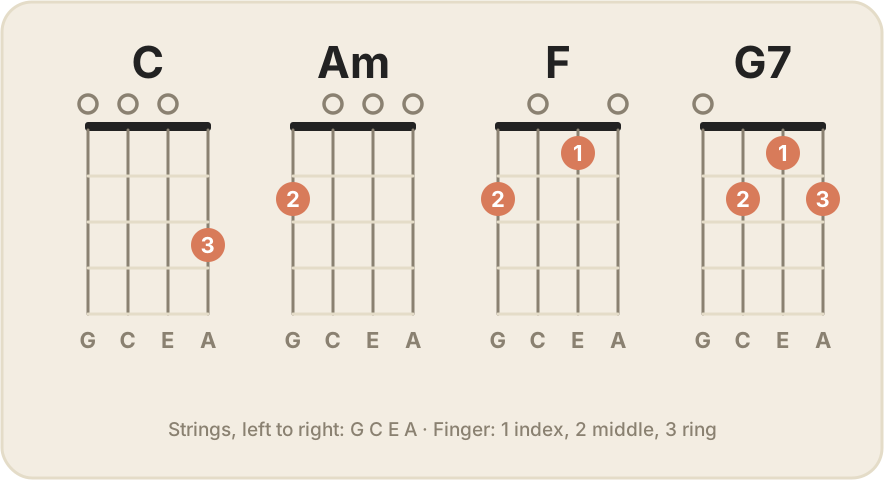
If a fretted string is dull or buzzing
- Fingertip too far from the fret. Place it just behind the fret wire, not in the middle of the space and not on top of the wire.
- Not enough pressure. Press until the note is clear, then relax a little. More force than that only tires the hand.
- Finger lying flat. Use the tip, not the pad, so the finger does not lean on the next string.
If an open string is dull
Another finger is probably touching it lightly. The side of a fingertip or the underside of a finger often rests on a neighbouring string. Arch the finger so that only its tip touches the string you mean to hold. Then pluck the open string again.
Change one thing at a time
After each small change, pluck the strings one at a time again. If the string becomes clear, the cause was that one. If it does not, change the next thing. Doing three things at once hides which one helped.
If every string buzzes at every fret on the instrument, the cause may be the ukulele itself rather than your fingers. A music shop or a luthier can check it.
Then strum
When all four strings ring one at a time, strum the chord slowly, one downstroke per bar. If the dull sound returns only in the strum, look at which finger moves when you strum. Next, practise changing between two chords, starting from the shapes in our first-chord guide.
Want to repeat a hard chord slowly? Get Uku and explore its practice features under the app’s trial and unlock terms.