A 10-Minute Ukulele Practice Routine for Beginners
A useful short practice session has one small goal. You might aim to change Am to F without losing the count, or play four bars of steady downstrokes. You do not need to learn a new song every day.
Your ten minutes
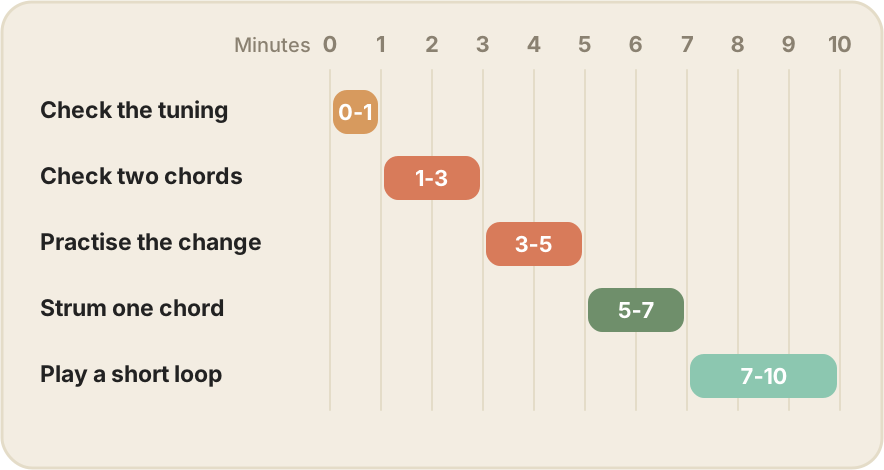
| Time | Task | What to notice |
|---|---|---|
| 0–1 min | Check GCEA tuning | Correct strings and target octave |
| 1–3 min | Check two chord shapes | Each string sounds clearly |
| 3–5 min | Practise the change between them | Arrive on a predictable beat |
| 5–7 min | Strum one chord at a comfortable tempo | Count stays even |
| 7–10 min | Play a short original loop | Keep going through the whole phrase |
For the final task, use C | Am | F | G7, one bar each, or just repeat C | Am if four chords are too much. Begin with one downstroke on beat 1 of each bar. Repeat at a tempo that leaves room to prepare.
Make tomorrow easier to start
Before putting the instrument away, write one sentence: “Next time I will practise F to G7 at the same slow tempo.” A specific next step is easier to act on than “get better at ukulele.”
If you record a short take, compare the timing and clarity with an earlier take made at the same tempo. A recording is feedback, not an exam. You may hear an uneven beat more easily on playback than while moving both hands.
Adjust the routine
If you have only five minutes, tune briefly, choose one change and finish with a tiny phrase. If you have more time, repeat the difficult section with breaks rather than adding a long list of new chords. Stop and reset when your hands feel strained.
Start with our tuning guide, first chords and chord-change exercise.
Prefer a practice path on your phone? Get Uku. Guided and advanced practice follows the app’s trial and unlock terms.